Power electronics is the application of solid-state electronics to the control and conversion of electric power. The goal is to take energy from a primary source (such as a battery or AC mains), convert it to the precise voltage and current required by a specific load (like a microcontroller or motor), and do so with maximum efficiency. As energy density increases, the challenge of managing heat dissipation and component stress becomes the primary engineering constraint.
Linear Regulation
The simplest method of reducing a DC voltage is through linear regulation. A Low Dropout Regulator (LDO) operates by controlling a transistor in its linear region to act as a variable resistor. It automatically adjusts its resistance to maintain a steady output voltage, regardless of changes in the input voltage or load current.
While LDOs provide exceptionally clean, noise-free power, their efficiency is fundamentally limited. The difference between the input voltage and the output voltage is entirely dissipated as heat. For example, stepping down a 12V source to supply 3.3V at 1 Ampere means the LDO must dissipate 8.7 Watts of thermal energy, requiring massive heatsinks and rendering them unsuitable for high-power differentials.
Switched-Mode Power Supplies (SMPS)
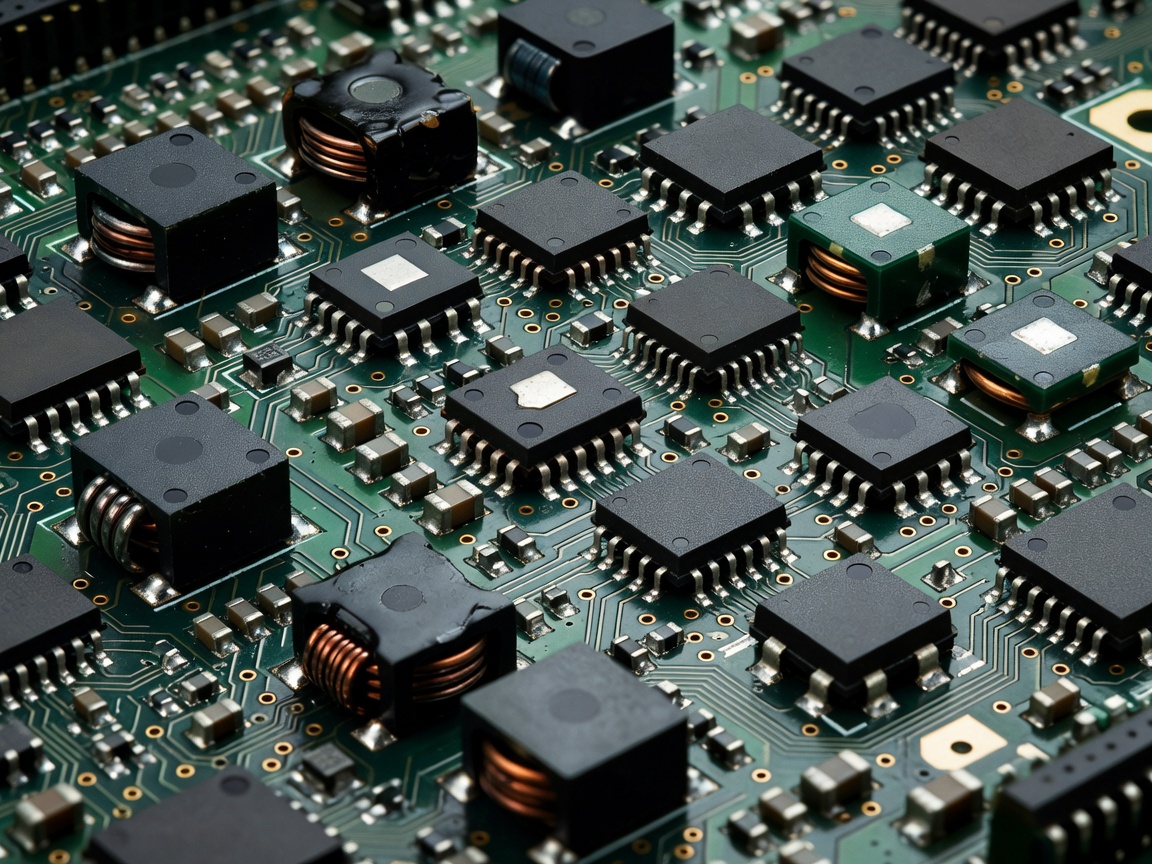
To overcome the thermal inefficiencies of linear regulators, engineers utilize Switched-Mode Power Supplies. Instead of operating a transistor as a variable resistor, an SMPS operates transistors as high-speed switches—fully on or fully off. In an ideal switch, there is either no voltage drop across it or no current flowing through it, meaning theoretical efficiency is 100%.
Buck Converters (Step-Down)
A buck converter reduces an input DC voltage to a lower output DC voltage. It achieves this by rapidly pulsing the input voltage into an inductor-capacitor (LC) filter network. When the switch is closed, energy is stored in the inductor's magnetic field. When the switch opens, a diode (or synchronous transistor) provides a path for the inductor current to continue flowing to the load. The output voltage is directly proportional to the duty cycle of the switching waveform.
Boost Converters (Step-Up)
A boost converter performs the opposite function, producing an output voltage higher than the input source. When the switch closes, current builds up in an inductor, storing magnetic energy. When the switch opens abruptly, the collapsing magnetic field generates a high-voltage spike. This spike is directed through a diode to charge an output capacitor. Boost converters are essential in battery-powered devices where a 3.7V lithium cell must drive a 5V logic circuit.
Component Selection Criteria
Designing a reliable SMPS requires selecting components that can survive harsh electrical stress and high-frequency operation.
- MOSFETs: The primary switching elements. Key specifications include RDS(on) (resistance when fully on) to minimize conduction losses, and gate charge (Qg) to minimize switching losses.
- Inductors: Must be chosen to handle the peak ripple current without their magnetic core entering saturation. Saturation causes inductance to drop to near zero, leading to catastrophic current spikes and transistor failure.
- Capacitors: Output capacitors must possess very low Equivalent Series Resistance (ESR) to effectively smooth the output voltage ripple and respond to high-frequency transient current demands.
Thermal Management
Even a highly efficient 95% SMPS delivering 100 Watts will generate 5 Watts of waste heat. In tightly packed modern electronics, this energy must be actively managed to prevent silicon failure.
Thermal management begins at the PCB layout level. Large unbroken copper planes are utilized to spread heat away from power ICs. Thermal vias are used to transport heat from the top layer of the board down into internal ground planes. For high-power density applications, passive heat spreading is insufficient, necessitating the mechanical attachment of aluminum or copper heatsinks, and sometimes forced air cooling, to maintain the safe operating junction temperature of the semiconductors.